Onboarding Best Practices for Kuikwit Employees and Customers
Whether you're bringing on a new hire or a paying customer, the first 30 days make or break the relationship. This is the no-fluff guide to onboarding best practices that actually hold up — across employee, customer, and B2B client onboarding.
Tag:
Published:
2 months ago
Updated:
2 months ago
Reading_time:
12 min read
What Onboarding...
Employee Onboar...
The 30-60-90 Pl...
Customer Onboar...
Check-Ins, Live...
B2B Customer On...
Onboarding Best...
Full FAQ — Onbo...
If Your Onboard...
Tag:
Published:
2 months ago
Updated:
2 months ago
Reading_time:
12 min read
Honestly, most onboarding is bad. Not broken — just quietly inadequate. Someone joins the team or signs up for your product, gets handed a login and a PDF nobody wrote with them in mind, and then everyone acts surprised when they disengage three weeks later. The first impression has already done its damage by then.
Question
Short Answer
What are
onboarding best practices?
Deliberate
steps that get new employees or customers to their first real win — fast, and
without unnecessary confusion.
Is a
formal onboarding process worth building?
Yes. The
cost of bad onboarding shows up as turnover, churn, and support volume. Good
onboarding pays for itself.
How does
structured onboarding actually work?
It maps
out what someone needs to know and do at each stage — and makes sure they
actually get there, with support.
What Onboarding Really Is — Not What Most Teams Think
Here's the thing most people get wrong about onboarding. They treat it like a handover. 'We've given them the information, so now they're onboarded.' That's not onboarding. That's just data transfer.
Onboarding is what happens between someone arriving and someone being genuinely capable. For an employee, that gap is usually 30 to 90 days. For a customer, it might be two weeks. Either way, what fills that gap — the clarity, the support, the small wins along the way — determines whether someone sticks around or quietly checks out.
The teams that do this well have usually stopped asking 'what do we need to tell them' and started asking 'what do they need to be able to do.' That shift sounds small. It changes everything. You stop designing onboarding around content and start designing it around outcomes. Which steps lead to the first moment where someone thinks 'okay, I've got this.' Build toward that moment and everything else follows.
And here's the uncomfortable part: most organisations haven't written down what that first success moment looks like. Not for employees, not for customers. So every manager runs it differently. Every account manager improvises. The experience varies wildly depending on who happened to be in the room. That inconsistency isn't a people problem. It's a process problem — and it's fixable.
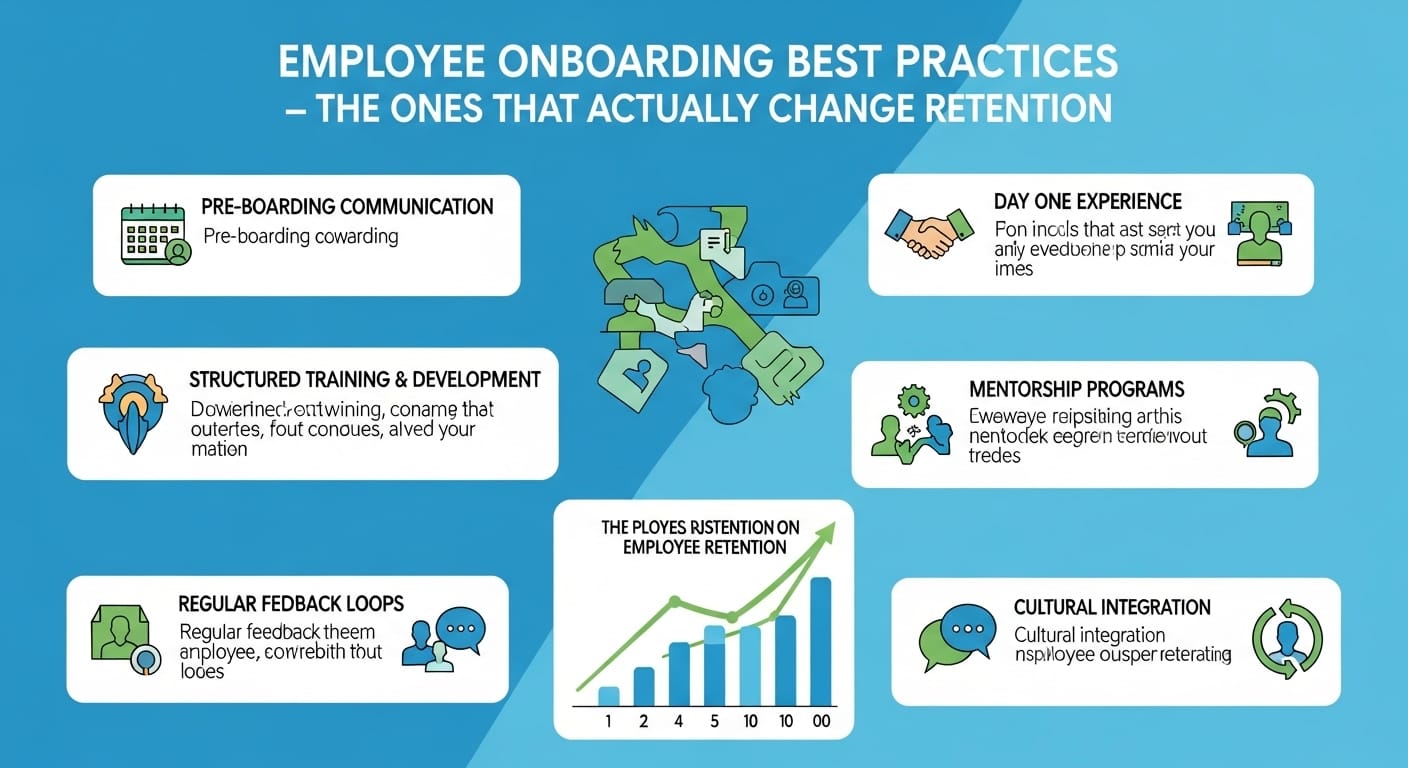
Employee Onboarding Best Practices — The Ones That Actually Change Retention
Pre-boarding. It's the week or two between someone signing their contract and walking through the door — and most companies treat it like dead time. It's not. New hires are anxious during that window. They've made a decision, it's already done, and the silence from their new employer fills up with second-guessing. A short check-in message, a heads-up about what day one looks like, maybe an intro to one teammate — none of this is complicated. It just requires someone to actually do it.
Day one is almost always overloaded. Eight hours of HR paperwork, IT setup, product training, culture decks, team lunches — crammed together because it feels efficient. It isn't. Nobody retains information under that kind of pressure. The stuff that matters on day one is much simpler: make the person feel like they were expected, get their tools working, and give them a clear picture of what the first week looks like. That's it. Save the rest for later.
The 30-60-90 Plan and Buddy System Done Right
The 30-60-90 day plan is talked about a lot and used well far less often. A real 30-60-90 plan isn't a list of training modules — it's a written agreement between the new hire and their manager about what success looks like at each stage. What decisions can they make independently by day 30? What project should they own by day 60? What does fully ramped actually mean at 90 days? When that conversation happens before someone starts, they have something to aim at. Without it, they're aiming at nothing and hoping it's the right direction.
Buddy systems work when they're actually set up properly. Not just a name on a list. Someone briefed, checking in on day three and day ten, who the new hire can ask embarrassing questions to without it affecting their review. This matters especially in sales roles — there's a solid argument for empowering your sales team with the right tools and support structure from day one, rather than leaving them to sink or swim. That relationship surfaces problems early, before they quietly become a resignation letter three months in.
Employee Onboarding: What Should Happen and When
Phase
What to Focus On
What Usually Goes Wrong
Pre-boarding
(before day 1)
Check-in
message, day 1 preview, team intro
Complete
silence from the employer
Day 1
IT
access, team intros, clear schedule — nothing more
Cramming
8 hours of information into one day
Days 2–5
Role
clarity, 30/60/90 goals, key contacts
No
written expectations — new hire is guessing
Week 2–3
First
real tasks, shadowing, tool training
Leaving
them to figure it out alone
Day 30
Manager
check-in, honest feedback conversation
This
meeting gets cancelled and never rescheduled
Day 60–90
Review
progress against goals, adjust if needed
Goals
were never written down to begin with
Customer Onboarding Best Practices — Getting Them to Value Before They Leave
Most customer churn in the first 30 days isn't about the product. It's about the gap between what someone expected and what they experienced. They signed up based on a promise — fast results, easy setup, clear ROI. Then they hit a confusing configuration screen on day two, didn't know who to ask, and quietly moved on. The product might have been exactly right for them. They just never got there.
Speed to value is the number that should be driving every decision in your customer onboarding process. Not completion rate on the onboarding checklist. Not time spent in the product. How quickly does a new customer do the actual thing they signed up to do? That first real outcome — not a demo, not a tutorial, but genuine use — is the moment where a customer decides whether this is worth continuing. Every step that sits between signup and that moment is friction. Cut as much of it as you can.
The channel setup is where a lot of customers first stumble. Getting them connected to the right platforms early — whether that's linking Facebook to their account or connecting other messaging channels — is often the step that unlocks everything else. When customers can't get past the initial setup, they don't ask for help. They just leave.
Check-Ins, Live Chat and Why Personalisation Actually Matters
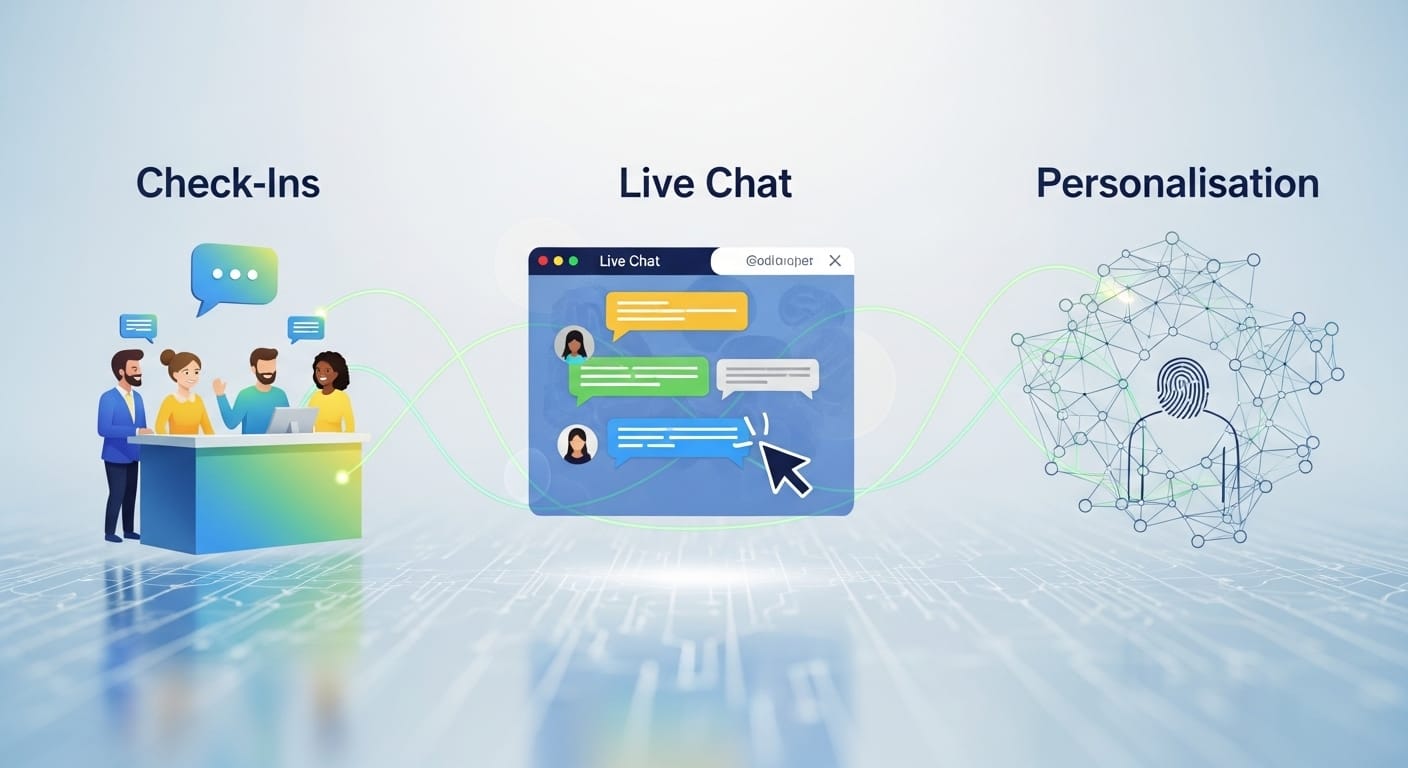
Proactive check-ins at days 3, 7, and 14 are one of the cheapest, highest-return things a customer success team can do. Not automated emails with a button that says 'book a call.' A short human message asking whether they got set up okay and whether anything's blocking them. Live chat support during the onboarding window changes the dynamic entirely — customers who might have quietly dropped off instead get an answer in minutes and keep going. Most people who stall don't cancel immediately. They go quiet for a week. That check-in at day 7 is often what catches them.
Personalisation matters too, and not in the 'add their first name to the email' way. A solo founder has totally different priorities than a 40-person operations team using the same product. Segmenting by size, role, or use case and adjusting the path accordingly makes customers feel seen. Tools that function as a unified communication platform rather than just a feature set make this kind of personalised onboarding significantly easier to pull off — everything the customer needs is in one place, not scattered across separate systems.
B2B Customer Onboarding Best Practices and What Client Onboarding Gets Wrong
B2B onboarding is slower and more political than consumer onboarding — and teams that don't account for that usually pay for it. When a business signs a contract, the person who signed it is rarely the person who'll use the product daily. There's an IT team who needs access to approve the integration. There's a manager who needs to sign off on data sharing. There's a frontline team who nobody's told yet. A single welcome email to the main contact doesn't reach any of those people. Mapping all the stakeholders in week one and having a specific plan for each of them is what separates B2B onboarding that works from B2B onboarding that just looks like it's working.
Kickoff calls are non-negotiable in B2B, even for self-serve products. A 30-minute call in the first week — not a sales call, just a 'let's make sure you're set up right and aligned on what you're trying to achieve' conversation — catches more problems earlier than any amount of documentation. Before that call, it's worth making sure you've thought through how the right CRM fits into your sales and customer structure — because misalignment between sales and the delivery team is one of the main reasons B2B onboarding stalls. The kickoff call is where those gaps show up first.
Documentation in B2B onboarding is usually written from the wrong angle. Most help docs explain what the product does. B2B customers need docs that explain how to do the specific thing they're trying to do in their specific context. 'How do I set up automated routing for a 12-person support team that works across three time zones' is more useful than 'here is how the routing feature works.' Building even three or four scenario-based guides for your most common use cases makes the documentation actually get used instead of just being thorough.
Employee vs Customer vs B2B Client Onboarding
Factor
Employee Onboarding
Customer Onboarding
B2B Client Onboarding
Typical
length
30–90
days
7–30 days
30–90+
days
Main goal
Clarity,
confidence, contribution
First
product outcome fast
Stakeholder
buy-in + full adoption
Biggest
risk
Disengagement
before 90 days
Churn
before first value
Slow
implementation, misaligned expectations
Key
success metric
Retention
at 6 months
Feature
adoption in 30 days
Renewal
rate, expansion revenue
Human
contact needed
High —
buddy, manager 1:1s
Medium —
proactive check-ins
Very high
— named CSM, regular calls
Worst
common mistake
Too much
info on day one
No clear
speed-to-value focus
One
contact, no stakeholder map
Onboarding Best Practices Most Processes Are Still Missing
Feedback loops. Almost nobody has them. Teams build an onboarding process, run it for six months, and never actually ask the people who went through it whether it worked. There are also platform-level features most onboarding processes still overlook entirely — small workflow tools and automations that could save hours every week but never get set up because nobody took the time to look. A ten-minute conversation at the end of someone's first month — 'what was clear, what wasn't, what would have helped earlier' — gives better data than any dashboard.
Milestone-based structure beats timeline-based structure for almost every type of onboarding. Timeline onboarding assumes everyone moves at the same pace. They don't. Some new hires take three days to feel settled; others take three weeks. Building onboarding around milestones — 'you progress when you've done X, not when the calendar says it's been 14 days' — respects that variation. People who move fast don't get held back by a rigid schedule. People who need more time don't get pushed forward before they're ready.
Defining the first win clearly — before you build anything else — is probably the single most useful thing you can do for any onboarding process. What is the one thing a new employee or new customer should be able to do on their own by the end of the first week? If you can't write that down in one sentence, your onboarding doesn't have a real target. 'Getting up to speed' is not a target. It's a feeling, and you can't design toward a feeling.
The Specific Mistakes That Quietly Kill Good Onboarding
Siloing it. Onboarding gets handed to HR, or to the customer success team, or to whichever manager the new person reports to — and nobody else is involved or accountable. So different people go through wildly different experiences depending on who happened to be in their corner. Onboarding needs a real owner with cross-functional visibility. Not a committee — an owner. Someone who sees the whole process and is responsible for it working consistently.
Generic automated emails with no human follow-up. Most onboarding sequences are just a timed email chain that looks like communication but doesn't actually do the job. Customers who are confused after email three don't reply to email four. They just stop logging in. Employees who are overwhelmed after week one don't raise their hand. They start updating their LinkedIn. The automation should be the floor, not the ceiling. Real human touchpoints have to sit on top of it.
No defined first win — and no celebration when it happens. This sounds soft, but it isn't. The moment where someone does the thing they were supposed to learn how to do, independently, for the first time — that moment is important. Acknowledging it reinforces that they're on the right track. It sounds basic. Most processes skip it entirely. A quick message or a manager shoutout costs nothing and lands harder than you'd expect.
Full FAQ — Onboarding Questions People Actually Search
1. What is the most important thing in employee onboarding?
Role clarity — by a significant margin. A new employee can handle a lot of uncertainty. What they genuinely struggle with is not knowing what's expected of them in the first 30 days, who makes which decisions, and what success actually looks like in their specific role. Writing that down and handing it over before someone starts does more for early engagement than any amount of training content. You can teach skills. You can't give someone clarity they were never given.
2. How long should customer onboarding take?
For most software products, the target is getting a customer to their first meaningful outcome within 7 days of signup. That's not the end of onboarding — that's just the first checkpoint. Full onboarding, where a customer feels genuinely confident and independent, usually takes 2 to 4 weeks for simpler tools and 6 to 10 weeks for more complex platforms. The 7-day first-value milestone is what you should be designing toward first. Everything else follows from that.
3. What are the best practices for onboarding new employees remotely?
Remote onboarding demands more written documentation than in-person onboarding, because the ambient information people absorb in an office simply doesn't exist. That means being more explicit about what to expect each day, building a dedicated channel for questions that aren't urgent enough for a DM, and scheduling more frequent short check-ins in the first two weeks. Video calls help but aren't a substitute for clear written guidance on the role, the team, and the processes. Remote new hires need things spelled out. If something goes unsaid, it stays unknown.
4. How do you actually measure if onboarding is working?
Stop measuring completion. Measure outcomes. Completion tells you whether people went through the steps — it says nothing about whether those steps produced anything useful. For employees: track 90-day retention, time to first meaningful contribution, and 6-month performance review results. For customers: track feature adoption in the first 30 days, support ticket volume in weeks 1 and 2, and churn rate in months 1 through 3. Those numbers tell you exactly where the process is working and where it's losing people.
5. What is the difference between onboarding and orientation?
Orientation is a single event — usually day one or week one — that covers compliance, introductions, and logistics. Onboarding is the extended process that follows, running for weeks or months, focused on getting someone to full capability. Orientation is part of onboarding. It is not a substitute for it. A lot of organisations do orientation reasonably well and then stop — which is why so many people describe their first month as unsettled even when day one itself was fine.
6. How do B2B client onboarding best practices differ from consumer onboarding?
B2B onboarding is slower, involves more people, and carries higher stakes per account. Consumer onboarding can mostly run on automation with targeted human touchpoints. B2B almost always requires named contacts, kickoff calls, implementation support, and regular check-ins across the first 60 days. The failure mode in B2B isn't usually a bad product — it's misaligned expectations between whoever signed the contract and the team that actually has to use it. Mapping all the stakeholders early and making sure each of them has a clear path forward is the work most B2B teams skip.
7. What should a client onboarding checklist include?
At minimum: signed contract and defined scope, kickoff call scheduled in week one, all stakeholders identified with their roles listed, agreed success metrics written down, access and technical setup confirmed, a named point of contact on each side, and a check-in booked at the 30-day mark. The checklist isn't the onboarding — it's the safety net that stops critical things falling through the handoff gap between sales and whoever actually delivers the work.
8. Why do customers churn during the onboarding period?
Three reasons, almost always. First: they never reached a first meaningful outcome — the product felt harder than expected and they ran out of patience. Second: they got stuck and didn't know where to get help, so they quietly moved on. Third: the product didn't match what was sold, and onboarding is where that gap became undeniable. The first two are process problems with clear fixes — faster speed to value, proactive check-ins, accessible support. The third is a sales-product alignment issue that no onboarding process can fix.
If Your Onboarding Needs Work — Start Here
Don't try to rebuild the whole thing at once. Pick one audience — employee or customer — and define what a successful first 30 days looks like for them. Write it down in one page. Then look honestly at what you're currently doing and ask whether it's actually pointing toward that outcome.
Most onboarding processes don't need a full redesign. They need three things: a clearer first-win target, one real human touchpoint in week one, and someone who actually owns the process and checks whether it's working.
Start with those. The rest gets easier once you know what you're aiming at.
Secure and Reliable
Easy to use dashboard. Keep your worries aside! Have faith in Kuikwit’s strong security measures to keep your talks confidential while ensuring its data is not misplaced.